How a Shoe Design Patent Led to the Conviction of a Serial Killer
Prologue
This article discusses the crimes committed by serial killer Richard Ramirez, otherwise known as the Night Stalker, at a high level which may be distressing for some readers. That said, this is an intellectual property blog, not a true crime blog. Details of Richard Ramirez’s crimes which are unrelated to the Avia Aerobic shoe prints are not covered in this article.
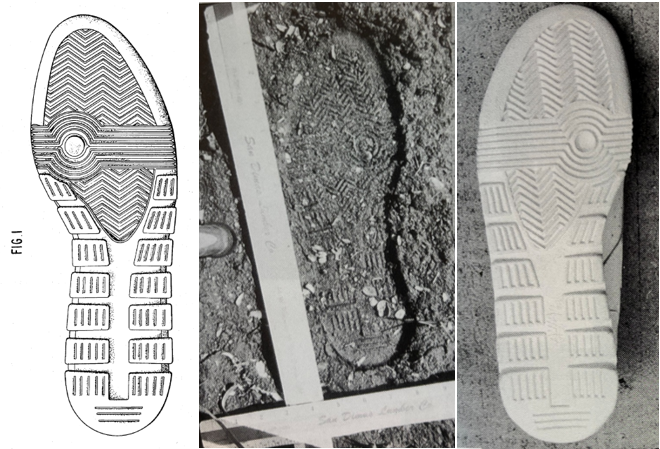
From left to right: Fig. 1 of U.S. Des. Patent No. 274,592, a photograph of the shoe print left in the Zazzara’s backyard, and the Avia Aerobic sole presented as evidence during the trial of Richard Ramirez.
The murder of Jennie Vincow on June 27, 1984, in her home in Glassel Park, Los Angeles, was the first crime attributed to the Night Stalker. [1]. Foreshadowing a recurring pattern in his future crimes, the Night Stalker gained entry to Jennie’s home through a window after first removing the screen. [2]. However, that particular evening he had significant difficulty removing screen with his gloves on, possibly because he was still high from using cocaine earlier in the night. [3]. In what would prove to be a costly misstep, the Night Stalker briefly removed his gloves to take off the window screen to open the window; In doing so, he left fingerprints behind on the window and on the screen. [4].
The Night Stalker wasn’t just a murderer; he was a burglar too. He was constantly in need of money to fuel his drug addiction. [5]. Sometimes he would burglarize two to three homes every day. [6]. On March 26, 1985, the Night Stalker was driving around Whittier, a city in Los Angeles County and remembered a house he had burgled the year before, and how wealthy the occupants were. [7]. The Night Stalker returned to that home, and broke in through a window on the southeast corner of the house by boosting himself up on a trashcan. [8]. Once in, the Night Stalker murdered its occupants, Vincent and Maxine Zazzara, and ransacked the home for valuables. [9]. This was the first crime scene the Night Stalker left his distinctive shoe prints, size 11 ½, behind for investigators to find; he left them on the east side of the house, on a flowerbed, as well as imprinted on the trash can outside of the southeast window. [10].
While homicide detectives were working the Zazzara case, a separate unit of law enforcement was investigating a series of child abductions in the Greater Los Angeles area. [11]. Between February and March 1985, at least three children were abducted, assaulted, and then released. [12]. In one of the abductions, a child was taken from her home and brought to a construction site where she was assaulted and then released. [13]. When the police were investigating the crime scene, they found the same distinctive shoe print left in the wet cement, also size 11 ½. [14]. Investigators didn’t know what shoe created the distinctive shoe print left behind at these crime scenes. So, they sent a detective to go from one shoe store to the next, trying on every shoe to see if one would be a match to their mystery shoe prints. [15]. After some trial and error, there was a hit: Avia Aerobics. [16].
cottonbro studio
On April 14, 1985, the Night Stalker broke into Lillian and Bill Doi’s hone in Monterey Park; Bill was murdered, but Lillian survived the attack. [17]. Once again, the Night Stalker left his shoe prints, size 11 ½ Avia Aerobics, behind at the crime scene: outside under Lillian Doi’s bedroom window, outside the primary bathroom window, on the back patio, and on a window screen left lying on the back patio, and imprinted in a puddle of mud between the street and the sidewalk in the front of the Doi residence. [18]. The detectives investigating the scene directed criminologists to plaster-cast the shoe prints. [19]. A little over a month later on May 19, 1985, the Night Stalker struck again, this time in Monrovia, a city the San Gabriel Valley in Los Angeles County. [20]. That night, he broke into the home of Mabel Bell, who lived there with her sister Florence Lang and assaulted them; while both women would survive the attacks, Mabel Bell would succumb to her injuries several months later. [21]. During the attack, the Night Stalker left behind a bloody Avia Aerobic shoe print on Florence’s bedroom floor. [22].
Just a few weeks later in June, the Night Stalker attempted to break into the home of John and Susan Rodriguez in Pico Rivera. [23]. After testing a few windows and finding them all locked, he found an open, but painted shut, window off of the dining room. [24]. Using a screwdriver, the Night Stalker separated the window from the frame which woke up Susan Rodriguez, who then woke up John. [25]. Unknown to the Night Stalker, John Rodriguez was a deputy for the Los Angeles Sherriff’s Office. [26]. The Night Stalker quickly retreated unseen, but left behind his size 11 ½ Avia Aerobic shoe prints in the dirt outside under the dining room window, which John covered with a plastic box until the police arrived. [27].
The Night Stalker next ventured to Arcadia, a city northeast of Los Angeles, on July 2, 1985, where he murdered and burglarized Mary Louise Cannon. [28]. He left behind two partial bloody shoe prints: one in the nap of a rug and another on a dirty tissue. [29]. While the full shoe print was not visible, investigators cut the nap of rug out and shipped it to a crime lab so it could be photographed and measured under optimal conditions. [30]. Once they finished their investigation of the crime scene, lead detectives Frank Salerno (who famously helped apprehend another serial California killer, the Hillside Strangler) and Gil Carrillo met with Captain Bob Grimm and presented their theory that one person was responsible for the string of horrendous crimes in Los Angeles County. [31]. After reviewing Frank and Gil’s evidence showing how all the crimes were linked together, including the size 11 ½ Avia Aerobic shoe prints, Captain Grimm assembled official task force of the best detectives in Los Angeles County to catch the Night Stalker. [32]. A member of the task force, criminalist Jerry Burke, was dispatched to Portland to interview the designer of the Avia Aerobic shoe. [33].
TREEDEO.ST
Three days later in the early hours of July 5, 1985, the Night Stalker drove to Sierra Madre, near Arcadia. [34]. He broke into a home belonging to the Bennett family, who were all soundly sleeping after celebrating the Fourth of July. [35]. The Night Stalker attacked Whitney Bennett while she slept, but abandoned the assault after he was spooked by electric sparks emanating from a telephone cord he cut. [36]. Although Whitney would survive the attack, she could not remember anything from the assault. [37]. The Night Stalker, however, left a bloody Avia Aerobic shoe print on Whitney’s pink comforter. [38].
A few days later, the Night Stalker returned to Monterey Park where hit two homes back-to-back: he first murdered and burglarized Joyce Lucille Nelson, then assaulted and burglarized Sophie Dickman. [39]. While no shoe prints were left at Sophie Dickman’s home, the Night Stalker left his Avia Aerobic shoe prints on a flowerbed and on the front and back patios of Joyce Nelson’s. [40]. Horrifyingly, he also left a partial shoe print on Joyce’s face. [41].
As investigators mulled over these new crime scenes, Jerry Burke returned from Portland after meeting with Jerry Stubblefield, inventor of the Avia Aerobics, with some interesting news. [42]. The shoe prints they found at all the crime scenes were unique to Avia Aerobics; that is, the design of the shoe sole that created that shoe print was exclusively and only used for the Avia Aerobics. [43]. Jerry provided investigators sales data for Avia Aerobics: only 1,356 pairs of Avia Aerobics were imported into the U.S. from Taiwan for distribution, which tracked because Avia was a relatively new company, formed just a few years back in 1979. [44]. Based on living victims’ descriptions that the Night Stalker dressed in all black, investigators reasoned the Night Stalker likely wore black Avia Aerobics. [45]. Of the 1,356 pairs of Avia Aerobics imported, only six pairs were black and size 11 ½, five of which went to Arizona, and only one came to Los Angeles. [46]. Now certain that a single person was behind all of these heinous crimes, pictures of Avia Aerobics were sent to all 63 police jurisdictions in Los Angeles County. [47].
Around this time, the Night Stalker discovered that the news was actively covering his crimes. [48]. He was unpleasantly surprised to learn that the police were able to determine that the crimes were all committed by one person, although the media did not report how investigators were able to link them. [49]. While displeased, the Night Stalker was undeterred, and on July 20, 1985, he again hit two homes in the same night. [50]. He first murdered Max and Lela Kneiding in their home in Glendale, just six miles north of Los Angeles. [51]. The Night Stalker then drove north to the city of Sun Valley and entered the home of Chainarong and Somkid Khovananth through their open sliding glass door. [52]. There, he murdered Chainarong and assaulted Somkid. [53]. His size 11 ½ Avia Aerobic shoe prints were found in the back patio and a hallway in the Khovananth home. [54].
With the news coverage of his crimes now reaching a fever pitch, the Night Stalker decided to head to San Francisco, reasoning that it would be easier to get in and out of homes there since the residents would not be as cautious. [55]. His first San Francisco victims were Peter and Barbara Pan, whom he murdered in the early hours August 18, 1985, after gaining entry through a window on the side of the house after removing the screen. [56]. The Night Stalker again left his Avia Aerobic shoe prints at the scene. [57]. Frank Salerno and Gil Carrillo learned of the Pan double murder later that morning through a colleague who heard it over a CB channel. [58]. Frank and Gil flew to San Francisco that afternoon and met with the San Francisco investigators and told them everything they knew about the Night Stalker: his crimes, how dangerous he was, and the evidence he was leaving behind, including the size 11 ½ Avia Aerobic shoe prints. [59]. The information was quickly passed along to San Francisco Mayor (later Senator) Dianne Feinsten, who ordered a news conference at City Hall. [60]. Frank Salerno and Gil Carrillo became enraged watching the news conference as Mayor Feinstein revealed that investigators linked the infamous Night Stalker of Los Angeles to crimes in San Francisco through ballistics and his distinctive Avia Aerobic sneakers. [61].
The Night Stalker watched the news conference on TV. [62]. He had no idea that he was leaving such distinct shoe prints or ballistic evidence at his crime scenes. [63]. Around 8 p.m. that evening, the Night Stalker walked across the Golden Gate Bridge and dropped his Avia Aerobic shoes into the bay and watched them float into the ocean, never to be recovered. [64].
Patents and the Shoe Industry
Mathias Reding
Under U.S. patent law, there are three types of patents: utility patents, which protect processes, machines, manufactures, and compositions of matter, design patents, which protect an “ornamental design for an article of manufacture,” and plant patents, which protect asexually reproduced plants. [65]. The shoe industry makes great use of both utility and design patents to protect the functional and ornamental features of shoes and shoe-making.
Shoe Utility Patents
As it pertains to shoes, utility patents generally protect the functional aspects of shoes, methods of making shoes, or improvements to shoes. [66]. Early 19th century shoe utility patents were directed to “pegging” machines, which were machines which use a wooden pick or peg to unite a shoe sole and shoe upper. [67]. Some of those patents include “Boot and Shoe Pegging Machine,” patented April 3, 1834, and issued to N.A. Fisher, and a “Pegging Jack,” which was issued to F. Gray on April 6, 1832. [68].
Utility patents for athletic shoes and sneakers come much later, in the early 20th century, around the time the Olympic games began including the marathon as an event. [69]. One of the earliest athletic shoes was U.S. Patent No. 1,392,704, issued on October 4, 1921, for athletic shoes with spikes. [70].
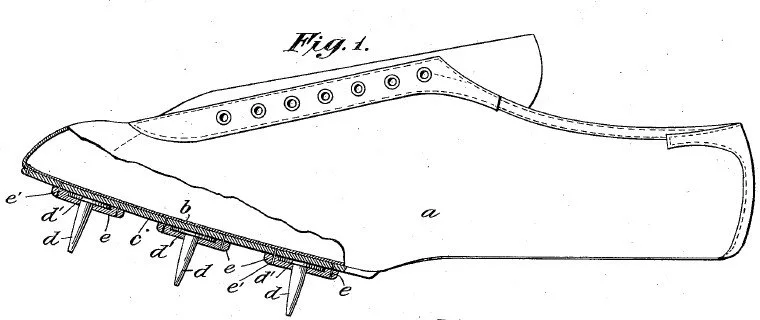
Fig. 1 from U.S. Patent No. 1,392,704, for "Athletic Shoe"
The 1950s to 1970s saw numerous breakthrough utility patents for athletic shoes, including running shoes. [71]. Perhaps the most famous shoe patent from this time period is Bill Bowerman’s waffle outsole, patented on February 26, 1974. [72]. Bill was the head track coach at the University of Oregon for over twenty years, and he left his mark in the sport. [73]. He was one of the first coaches to record his players on film so they could study their performance. [74]. Bill was also a prolific inventor, he consistently worked on improving athletic equipment and gear, and holds multiple patents for athletic shoes. [75]. Beginning in the 1950s, Bill Bowerman began developing what would later become Nike’s Waffle Trainer, a lightweight shoe with a latex and rubber outer sole having a plurality of raised nubs, which gave the shoe excellent traction without adding weight like metal spikes did. [76]. Bill used his wife’s waffle iron to make the raised nubs in the prototypes. [77].
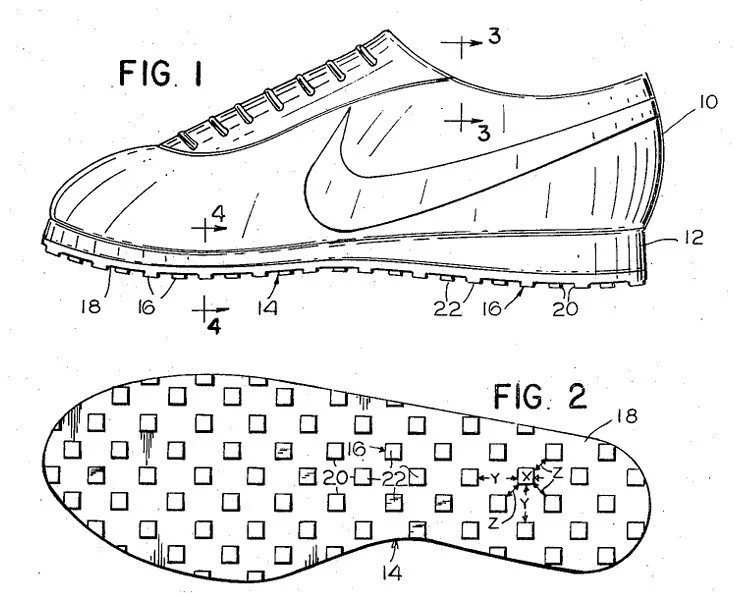
Fig. 1 and Fig. 2 from U.S. Patent No. 3,793,750 for "Athletic Shoe for Artificial Turf"
The Waffle Trainer and its outsole, U.S. Patent No. 3,793,750, are considered one of the most important inventions in the athletic shoe industry. [78]. The Waffle Trainer and waffle outsole was so popular other brands were forced to come up with their own versions in order to compete; Puma created a shoe with round nubs and Saucony made triangle-shaped nubs. [79]. This patent also earned Bill Bowerman his induction into the National Inventors Hall of Fame in 2014. [80].
Shoe Design Patents
While utility patents were issued pursuant to the first Patent Act, passed in 1790, design patents were not issued until much later in 1842 with the passage of the third Patent Act. [81]. As covered in prior blog post, design patents are issued to “[w]hoever invents any new, original and ornamental design for an article of manufacture,” where an “ornamental design” is “an aesthetically pleasing appearance that is not dictated by function alone.” [82]. As it pertains to shoes, which are an article of manufacture, design patents may protect the shape of a shoe, a surface design of a shoe, or both. [83]. An early design patent for protecting the shape of ladies boots and shoes, U.S. Des. 3,400 was issued to Amelia Strang in 1869. [84].
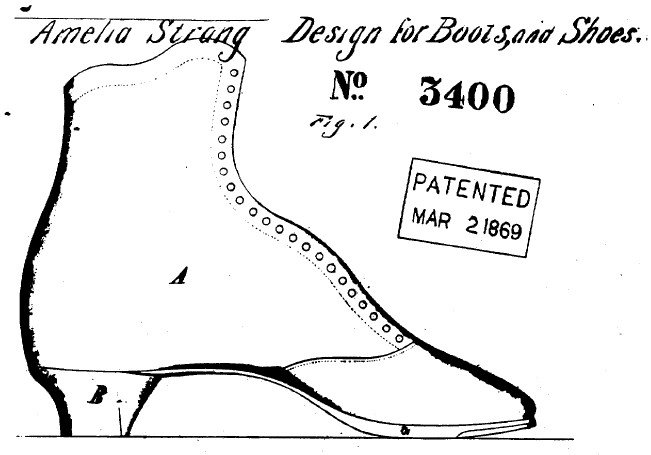
Fig. 1 from U.S. Des. Patent No. 3400 for "Design for Boots, and Shoes"
However, a design patent does not need to cover the entire shape or design of a shoe (or boot). For example, Air Jordan 17s, an iconic Nike sneaker, are protected by three different design patents: US D456,121 S1 protects the “spat” of the Air Jordan 17, US D456,129 S1 protects a “portion” of the Air Jordan 17, and US D466,277 S1 protects another, different “portion.” [85].
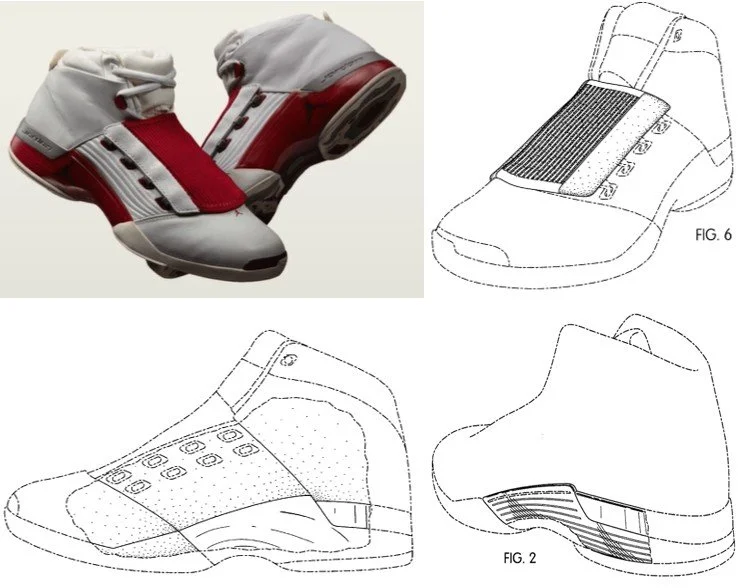
Clockwise from top left: Nike Air Jordan 17’s in the red and white variation released in 2002, Fig. 6 of US D456,121 S1, Fig. 2 of US D466,277 S1, and Fig. 2 of US D456,129 S1.
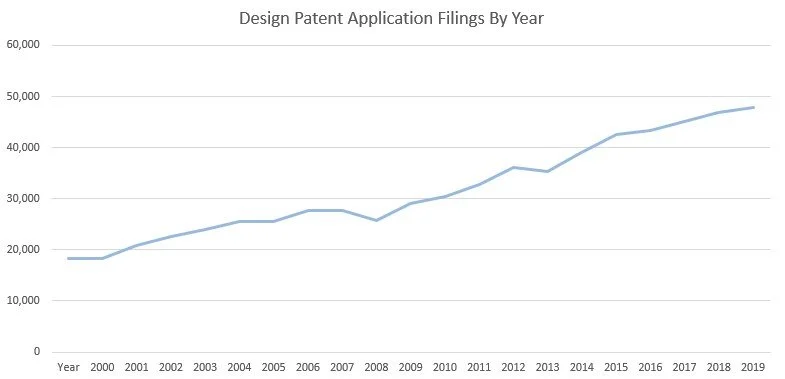
Design patents have significantly increased in popularity in the modern era. The 21st century has seen a steady increase in design patent filings across all classes, as shown in the below chart. In 2000, the number of design patent applications filed was 18,292. [86]. In 2020, 47,838 design patent applications were filed, more than twice the amount filed in 2000. [87]. With regards to the shoe industry specifically, 8,849 design patents were granted in the U.S. Design Patent Class D02 “apparel and haberdashery” (men’s clothing) from 2001 to 2015 (latest data available from the U.S. Patent and Trademark Office). [88]. Design patents for sneakers and shoes account for a significant portion of those design patents, and some shoe companies like Nike hold an impressive portfolio of design patents. [89]. As of June 2022, Nike has over 7,000 issued design patents, the majority for footwear. [90].
The Avia Aerobics and the Conviction of Robert Ramirez
Avia was founded in 1979 by Jerry Stubblefield, a former athlete, a college track and cross-country coach, and Olympic Trials finalist. [91]. Jerry was not only the founder and president of Avia, but he was also their chief designer and mold and pattern maker. [92]. Jerry had a patent-forward business acumen; between 1977 and 1987 (when Avia was acquired by Reebok), Jerry filed 31 patent applications relating to shoes. [93].
Many of Jerry’s patent applications, both design and utility, related to shoe soles, including U.S. Design Patent No. 274,574, the sole of the Avia Aerobics which created the shoe prints Richard Ramirez inadvertently left at many of his crime scenes. [94]. As discussed in more detail in a prior blog post, the owner of a design patent has the exclusive right to make, use, sell, offer to sell, and import their design in the United States. [95]. And so, at the time of the Night Stalker’s reign of terror, Avia and only Avia had the right to sell shoes which had the sole patented by U.S. Design Patent No. 274,574.
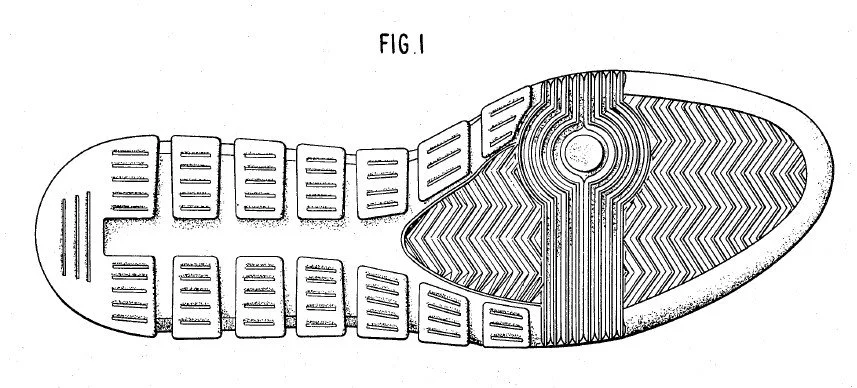
Fig. 1 of U.S. Des. Patent No. 274,574
During Richard Ramirez’s trial, Jerry Stubblefield testified on behalf of the government regarding the Avia Aerobics, specifically he testified that the sole of the Aerobics was different than other Avia shoes. [96]. Additionally, Avia data processing manager Jeff Brewster also testified at Richard Ramirez’s trial regarding the sales data of the Avia Aerobics, including how only one pair of black of Avia Aerobics, size 11 ½, was sold in Los Angeles. [97].
But how did the prosecution link the single pair of size 11 ½ black Avia Aerobics, sold in L.A. and ostensibly worn by the Night Stalker, to Richard Ramirez?
The prosecution introduced the evidence from the murder of Jennie Vincow, the first crime attributed to the Night Stalker. Recall that the Night Stalker left his fingerprints behind when he removed the window screen. [98]. Those fingerprints were a match to Richard Ramirez. [99]. Next, the prosecution introduced evidence from the burglary of Clara Hadsall, who was deceased at the time of trial. [100]. The prosecution showed the jury that the burglar broke into Clara’s home through a window (the same mode of entry the Night Stalker uses) and lowered himself on to the kitchen sink. [101]. In doing so, the burglar left a palm print and fingerprints on the kitchen sink. [102]. Those fingerprints? They were also a match to Richard Ramirez. [103]. Then the prosecution revealed that the burglar left shoe prints in Clara’s kitchen and in the dirt outside of the house, shoe prints from Avia Aerobics, size 11 ½. [104].
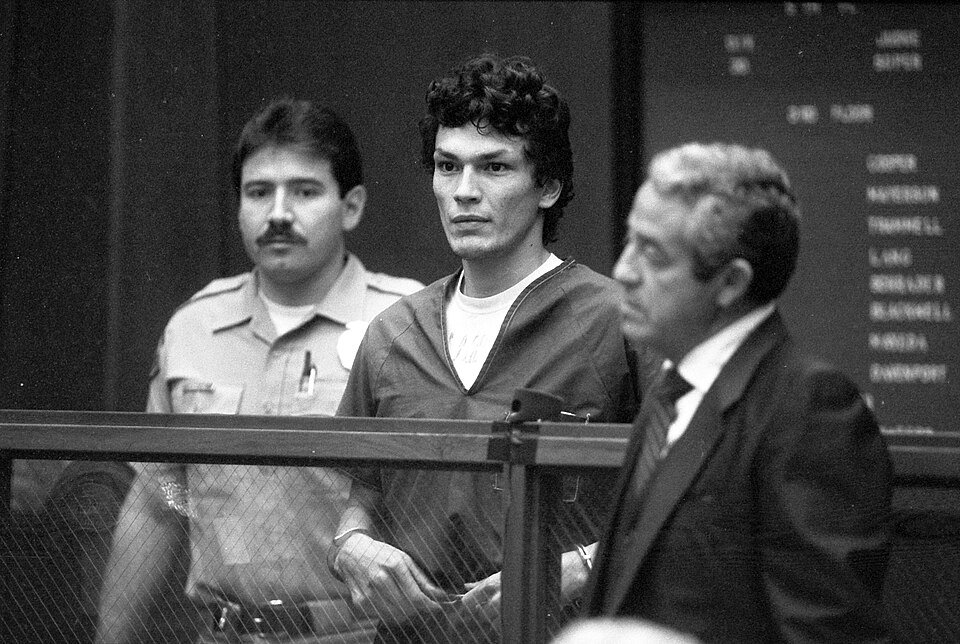
"Richard Ramirez with attorney" by Iris Schneider, Los Angeles Times is licensed under CC BY 4.0.
And so, the prosecution was successfully able to link the size 11 ½ Avia Aerobic shoe prints to Richard Ramirez’s fingerprints. When the jury began their deliberations, the first crime they voted to convict was the murder of Jennie Vincow. [105]. They then voted to convict Richard Ramirez on all the assaults where the Avia Aerobic shoe prints were present. [106].
Jerry Stubblefield probably did not expect that patenting the soles of the Avia Aerobics would land him on the witness stand in one of the most high-profile criminal cases in U.S. history. What is a bit more likely is that Jerry chose to invent his own novel shoe sole design, and file a patent application for it, so he could create exclusivity in the marketplace for his up-and-coming shoe company. In doing so, Jerry ensured that Avia and Avia alone would be the only shoe company in the entire country who could make, use, sell, offer for sale, and import shoes that have that specific sole design. The unintended result of that is investigators were able to determine that one person was responsible for dozens of heinous crimes, and the jury was able to convict Richard Ramirez for those crimes. In a way, the story of the Avia Aerobics and Richard Ramirez is a strange, but compelling example on the power of exclusive rights attached to U.S. patents.
Endnotes
[1] See Philip Carlo, The Night Stalker: The Life and Crimes of Richard Ramirez (1996) at p. 1-7; see Edwin Chen. “Trial Reveals the Trail of Clues That Led Police to Night Stalker Suspect Ramirez.” Los Angeles Times. Feb 6., 1989, https://www.latimes.com/archives/la-xpm-1989-02-06-me-1275-story.html.
[2] Carlo, supra note 1, at pp. 5-6; see Chen, supra note 1.
[3] Carlo, supra note 1, at p. 6.
[4] Id. pp. 6, 10.
[5] See id. at p. 11.
[6] See id.
[7] Id. at p. 28; see Chen, supra note 1.
[8] Carlo, supra note 1, at pp. 29, 33.
[9] Id. at pp. 28-33.
[10] Id. at pp. 33-34.
[11] Night Stalker: The Hunt for a Serial Killer: Devil in the City of Angels (The Intellectual Property Corporation Jan. 13, 2021); see Carlo, supra note 1, at p. 35.
[12] Devil in the City of Angels, supra note 13.
[13] Id.; see Carlo, supra note 1, at p. 35.
[14] Devil in the City of Angels, supra note 13; see Carlo, supra note 1, at p. 35.
[15] Night Stalker: The Hunt for a Serial Killer: Anyone Could Be Next (The Intellectual Property Corporation Jan. 13, 2021).
[16] Id.
[17] Carlo, supra note 1, at pp. 37-43.
[18] Id. at p. 43; Chen, supra note 1.
[19] Carlo, supra note 1, at p. 43.
[20] Id. at p. 44.
[21] Id. at pp. 44-53, 83.
[22] Id. at p. 46; see Chen, supra note 1.
[23] Carlo, supra note 1, at p. 54; Night Stalker: The Hunt for a Serial Killer: Anyone Could Be Next (The Intellectual Property Corporation Jan. 13, 2021).
[24] Carlo, supra note 1, at p. 54; Anyone Could Be Next, supra note 15.
[25] Carlo, supra note 1, at p. 54; Anyone Could Be Next, supra note 15.
[26] Carlo, supra note 1, at p. 54; Anyone Could Be Next, supra note 15.
[27] Carlo, supra note 1, at p. 55; Anyone Could Be Next, supra note 15.
[28] Carlo, supra note 1, at pp. 61-62.
[29] Id. at p. 63; see Chen, supra note 1.
[30] Carlo, supra note 1, at p. 63.
[31] Id. at p. 64.
[32] Id. at pp. 64-65.
[33] Id. at p. 64.
[34] Id. at p. 66.
[35] Id. at p. 66; Devil in the City of Angels, supra note 13.
[36] Carlo, supra note 1, at pp. 65-66.
[37] Id. at p. 66; Devil in the City of Angels, supra note 13.
[38] Carlo, supra note 1, at p. 70; Devil in the City of Angels, supra note 13.
[39] Carlo, supra note 1, at pp. 73-76.
[40] Id. at p. 79; see Chen, supra note 1.
[41] Carlo, supra note 1, at p. 79.
[42] Id.; Anyone Could Be Next, supra note 15.
[43] Anyone Could Be Next, supra note 15.
[44] Anyone Could Be Next, supra note 15; but see Carlo, supra note 1, at p. 79 (Carlo reports that 1,354 pairs were imported, not 1,356. At the author’s discretion, the number of pairs referenced in this article is based on the figure from Anyone Could Be Next because it was provided firsthand by Gil Carrillo and Frank Salerno, the lead detectives on the case).
[45] Anyone Could Be Next, supra note 15; see Carlo, supra note 1, at p. 79.
[46] Anyone Could Be Next, supra note 15; but see Carlo, supra note 1, at p. 79 (Carlo reports that only six pairs of Avia Aerobics were sold in L.A., and only one of those six pairs was a size 11 ½. At the author’s discretion, the explanation from Anyone Could Be Next is used in this article, see supra note 44).
[47] Carlo, supra note 1, at p. 80.
[48] Id. at p. 84.
[49] See id.
[50] See id. at pp. 84-89.
[51] See id. at pp. 84-85.
[52] Id. at pp. 86-87.
[53] Id. at pp. 86-90.
[54] Id. at p. 89; see Chen, supra note 1.
[55] See Carlo, supra note 1, at p. 110.
[56] Id. at p. 111.
[57] Id. at p. 256.
[58] Id. at p. 112.
[59] Id. at pp. 112-113.
[60] Id. at p. 113.
[61] Id.; see SF Weekly Staff. “Yesterday's Crimes: How Dianne Feinstein Tipped Off the Night Stalker.” San Francisco Weekly. Mar. 17, 2016. https://www.sfweekly.com/archives/yesterdays-crimes-how-dianne-feinstein-tipped-off-the-nightstalker/ article_c2b7035f-39f0-511b-b254-6788582e57cc.html.
[62] Carlo, supra note 1, at p. 114.
[63] Id.
[64] Id.
[65] 35 U.S. Code § 101; 35 U.S. Code § 171; 35 U.S. Code § 161.
[66] See Steve Brachmann. “The Evolution of the Modern Athletic Shoe: A Patent History.” IPWatchdog. May 18, 2014. https://ipwatchdog.com/2014/05/18/the-evolution-of-the-modern-athletic-shoe-a-patent-history/; see Sara Desai, Comment, Street Smarts: The Race to Patent Rights in Athletic Footwear, 30 Jeffrey S. Moorad Sports L.J. 342, 360 (2023).
[67] Patent Public Search – boots OR shoes; https://ppubs.uspto.gov/pubwebapp/; “The Natick Shoe Industry.” Natick Historical Society, https://www.natickhistoricalsociety.org/the-natick-shoe-industry (last visited Apr. 16, 2026).
[68] See U.S. Patent No. 6,986 X; see U.S. Patent No. 8,132 X.
[69] Brachmann, supra note 66.
[70] Brachmann, supra note 66; U.S. Patent No. 1,392,704
[71] Brachmann, supra note 66; Brian Metzler. “6 Patents That Changed Running Shoe Design.” run. Jun. 15, 2020, https://run.outsideonline.com/gear/road-shoes/6-patents-that-changed-running-shoe-design/.
[72] Metzler supra note 71; U.S. Patent No. 3,793,950.
[73] “William Bowerman.” Nat’l Inventors Hall of Fame, https://www.invent.org/inductees/william-bowerman (last visited Apr. 16, 2026); see Brachmann, supra note 66
[74] Brachmann, supra note 66.
[75] Id.
[76] Nat’l Inventors, supra note 73; Brachmann, supra note 66.
[77] Nat’l Inventors, supra note 73; Brachmann, supra note 66.
[78] Metzler, supra note 71.
[79] Id.
[80] Brachmann, supra note 66; Nat’l Inventors, supra note 73.
[81] Gene Quinn. “A Brief History of Design Patents.” IPWatchdog. Jan. 11, 2014, https://ipwatchdog.com/2014/01/11/design-patent-history/.
[82] 35 U.S. Code § 171; Bonito Boats v. Thunder Craft Boats, 489 U.S. 141, 148, 109 S. Ct. 971 (1989).
[83] Irene Calboli and Gabrielle Armstrong, Design Patents in the Fashion Industry: A U.S. Perspective, HANDBOOK OF FASHION LAW, Oxford University Press (forthcoming Jan. 9, 2024). Available at SSRN: https://ssrn.com/abstract=4663112.
[84] U.S. Des. 3,400.
[85] See Calboli, supra note 83.
[86] See “U.S. Patent Statistics Chart Calendar Years 1963 – 2020.” U.S. Patent and Trademark Office Patent Technology Monitoring Team (PTMT), https://www.uspto.gov/web/offices/ac/ido/oeip/taf/us_stat.htm (last accessed Apr. 16, 2026).
[87] See id.
[88] See Calboli, supra note 83; “Patent Counts By Class By Year JANUARY 1977 -- DECEMBER 2015.” U.S. Patent and Trademark Office Patent Technology Monitoring Team (PTMT), https://www.uspto.gov/web/offices/ac/ido/oeip/taf/cbcby.htm (last accessed Apr. 16, 2026).
[89] Calboli, supra note 83.
[90] Id.
[91] See Anyone Could Be Next, supra note 15; see “Avia High Performance Shoes 1985 Vintage Sneaker Ad.” The Deffest, https://www.thedeffest.com/vintage-ads/tag/avia+shoes (last accessed Apr. 16, 2026).
[92] The Deffest, supra note 91.
[93] Google Patents search – Inventor = Jerry Stubblefield, https://patents.google.com/?inventor=Jerry+Stubblefield&oq=by+Jerry+Stubblefield&sort=old&page=2; see The Deffest, supra note 91.
[94] See Google Patents search, supra note 93; see U.S. Design Patent No. 274,574.
[95] 35 U.S. Code § 271(a).
[96] Carlo, supra note 1, at pp. 256, 341.
[97] Id. at p. 340.
[98] Id. at p.10.
[99] Id. at p. 284.
[100] Id.
[101] Id.
[102] Id.
[103] Id.
[104] Id.
[105] Id. at pp. 381-382.
[106] Id. at pp. 381-382.